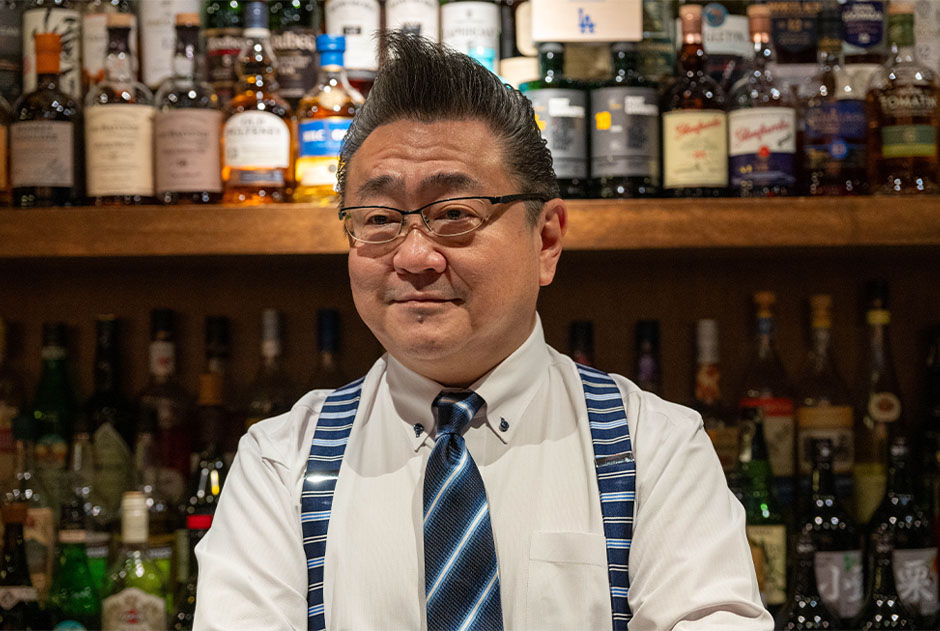
- Hidetsugu Ueno
- Owner Bartender, Bar High Five / President, Nippon Bartenders’ Association (N.B.A.) / Member of the Board of Councillors, Cocktail Culture Foundation
Born in 1968, Ueno is from Sapporo, Hokkaido. He played baseball through elementary school, junior high school, and high school, and American football at university. He also spent six months studying abroad in the United States. After graduating from university and studying at the Japan Bartenders School, he began working in Ginza, Tokyo. He joined Star Bar Ginza when it opened in 2000 and honed his craft under Hisashi Kishi. In 2008, he became independent and opened Bar High Five in Ginza. The bar was ranked No. 3 in the world in 2013 and No. 18 in 2019 in The World’s 50 Best Bars, and in 2020 received the special Heering Legend of the List award, which honors bars that have delivered consistently outstanding performance.
Among his individual honors, he received the Tales of the Cocktail® Spirited Awards®’ International Bartender of the Year in 2016 and the Helen David Lifetime Achievement Award in 2024. At the Nippon Bartenders’ Association (N.B.A.), he served in international affairs through fiscal 2011 as the youngest director in the association’s history, and became president in 2024. In recognition of his skills and his many years of contribution to the industry, he received the Minister of Health, Labour and Welfare’s award for FY2021 Outstanding Skilled Worker (Contemporary Master Craftsman) in November 2021. In 2023, he was awarded the Medal with Yellow Ribbon in the Autumn Conferment of Decorations. He also supervised the Japanese edition of The Craft of the Cocktail by Dale DeGroff, published by Rakkousha.
with Bartender
Exploring the journeys and the thoughts that shape globally active bartenders behind the bar.
2026.10.22
Hidetsugu Ueno
The Craft of Cocktails Has No End
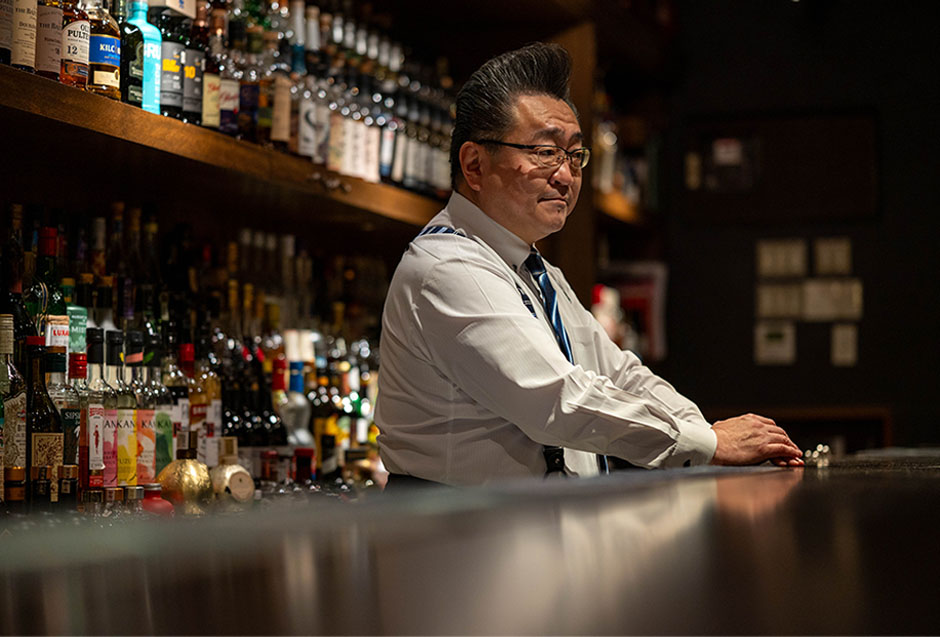
Hidetsugu Ueno of Bar High Five has received numerous awards in Japan and abroad in recognition of his outstanding bartending skills and warm, personable hospitality. His graceful movements behind the bar draw constant admiration not only from guests who know bars well, but also from fellow bartenders, who look to him as a model. We spoke with Ueno about his encounter with Hisashi Kishi, founder of Star Bar Ginza, as well as his views on what a bar and a bartender should be.
Text: Akira Suzuki / Photography: Koichi Mitsui / Composition: Contentsbrain / English Translation: LIBER
Interview Location: Bar High Five (Efflore Ginza5 Bldg. BF, 5-4-15 Ginza Chuo-ward, Tokyo)
My Dream Was to Run a Coffee Shop
――Could you tell us how you came to become a bartender?
When I was in high school, my dream was to run a coffee shop. I loved coffee, and I imagined creating a place with my kind of music and atmosphere, where the people I liked would gather..
Around the time I graduated from high school, Japan was at the height of the bubble economy, and land prices were soaring. Whenever I said in coffee shop interviews that I wanted to have a place of my own someday, they would ask whether my family already ran a coffee shop. When I said no, they would tell me to give the idea up. Unless you came from money, it would be impossible. They said it would take hundreds of millions of yen to open a single coffee shop. But of course, telling that to a 17- or 18-year-old made no difference. After graduating, I worked for about two years at a coffee shop in Sapporo that hired me.
Up until high school, I was on the baseball team and spent my days in a very disciplined environment. But once I started working and had a bit of money coming in, I began riding my motorcycle around at night, not going home, and my life quickly turned messy. At one point, I realized this was no good and thought I wanted to return to a more disciplined way of life. I still wanted to run a coffee shop, so I decided to study business administration. I applied to every business faculty at universities in Tokyo that I could, and went to the one that accepted me.
――You studied abroad in the United States while you were at university, didn’t you?
In my second year, I spent six months studying abroad through my university’s exchange program at a sister school in Washington State. That experience proved enormously helpful later in my life, but at the time, the opportunity just happened to be there in front of me. I could earn credits and still graduate in four years, and I thought any experience was worth having, so I decided to go. It was also my first time ever flying on an international flight.
――As you approached graduation from university, what became of your dream of running a coffee shop?
Around the time I moved to Tokyo, chain coffee shops like Doutor Coffee had just begun opening, and a blended coffee cost 150 yen. What struck me was that it tasted better than the coffee served at traditional coffee shops charging several times as much. And on top of that, people would spend two or three hours over a single cup, reading a book. There were no smartphones back then, so it really was books. Seeing that as a student made me seriously question whether I could actually make a living running a coffee shop.
Around that time, I suddenly remembered my uncle, who ran a small drinking place, mentioning things like bartenders and the bartenders’ association. That was it, I thought. In those days, many coffee shops served only coffee and other non-alcoholic drinks, but it occurred to me that serving alcohol as well might help boost sales. And if that was the case, I realized I needed to learn much more about alcohol.
However, I could not drink alcohol myself, and I had never even been to a bar, so I had no idea what to do. I called 104⋆¹, the telephone directory assistance service at the time, and got in touch with the Nippon Bartenders’ Association (N.B.A.). They told me about a bartending school, and after graduating from university, I enrolled in a one-month daytime course. That school no longer exists, but at the time it had been established in Shibuya, Tokyo, by senior figures in the N.B.A. and was intended for people who wanted to become bartenders or who wanted to learn the basics before entering the profession.
⋆¹ Telephone directory assistance 104: A service in which callers gave an operator the name they wanted to look up (such as a person’s or company’s name) or an address and were then provided with the corresponding telephone number. The service ended in late March 2026.
Relying on Senior Bartenders in Taking On the National Competition
The main part of the course consisted of practical training in techniques such as shaking and stirring before the lectures on things like knowledge of alcohol, and then, after the lectures, everyone would make two cocktails together. After completing the course, I took a job at a bar the school introduced me to. I was about 23 or 24 at the time. In fact, I had married an American woman I met while studying abroad, so I also needed to start earning money quickly.
The place I joined in Ginza was the kind of bar where customers bought bottles of whisky to keep behind the bar and were served whisky with water and similar drinks from them. Not long after I started, the person known as the chief suddenly quit, leaving me alone behind the counter. There was the proprietress, her younger sister, and a young hostess handling customer service, while I stayed quietly at the end, watching for the right moment to bring over an ashtray or some ice.
The first cocktail I ever served to a customer was a martini without an olive, made in a rocks glass with a muddler and served on the rocks. I still remember it vividly. The proprietress had told the customer, “He trained at bartending school, so he can make anything,” and that led to the order. But the bar did not even have the basic tools needed to make cocktails. In my head I was thinking, hold on a second, but it was not the kind of atmosphere where I could say I could not do it. After service that day, I told the proprietress, “For now, we at least need a mixing glass and a bar spoon,” and so she bought them for me.
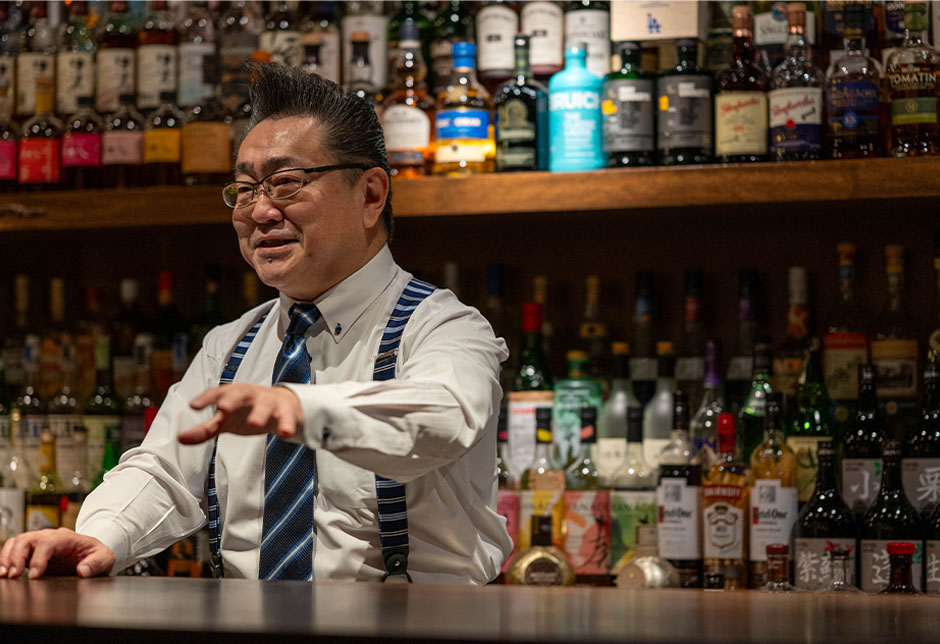
In the end, I worked there for about ten years. During that time, I wanted to meet other people working in the bar industry, so I joined what was then the Ginza branch of the N.B.A. and began taking part in its events.
At the time, competitions sponsored by drinks manufacturers were being held all the time. I casually entered my first one, made it through the preliminary round, and suddenly found myself competing in the national finals. But I had absolutely no idea what to do or how to get ready. At a complete loss, I turned to senior bartenders in the Ginza branch of the N.B.A. for guidance. By chance, at one of the branch’s cherry blossom viewing gatherings, Hisashi Kishi—who was known at the time as an ambitious and up-and-coming competition bartender—agreed to look over my movements and other aspects of my performance for the competition.
――So that was how you first met Mr. Kishi?
That’s right. Later, when Mr. Kishi went independent and launched Star Bar Ginza in 2000, he invited me to join the staff. We have known each other for a long time. People around us all refer to me as Mr. Kishi’s protégé, but the relationship between us has always felt more brotherly than master and apprentice. He is the kind of person who allows that kind of relationship, as long as I know my place.
Why I Left Star Bar to Open Bar High Five
――You also served for many years as a director in the N.B.A.’s International Affairs Department?
From around 2000, when I joined Star Bar, it became increasingly common in the bar industry for bartenders to be appointed as brand ambassadors by drinks manufacturers. At the same time, growing numbers of writers, editors, and people from drinks companies were coming to Japan from around the world. I ended up being the one who looked after them. I would answer their questions by email, and when they came to Japan, I would show them bars and sightseeing spots. After they returned home, they would tell others about me, and my name gradually spread by word of mouth.
People in the N.B.A. already knew that I could speak English, and ahead of the International Cocktail Competition⋆² held in Japan in 1996, I came to serve as an officer in the International Department newly established within the Ginza branch. Later, I was asked to help first with the International Department of what was then the Kanto-Tokai Regional Headquarters, and then with the Association’s International Affairs Department. That department also served as the point of contact with the International Bartenders Association (IBA), and my main duties were attending the annual general meeting and accompanying competitors representing Japan at the world championships. As a result, overseas business trips increased significantly.
⋆² The International Cocktail Competition: The former name of the World Cocktail Championship, the world’s premier cocktail competition organized by the IBA. The 1996 competition was held at the Grand Prince Hotel Shin Takanawa in Tokyo. At that competition, Hisashi Kishi won the long drink category.
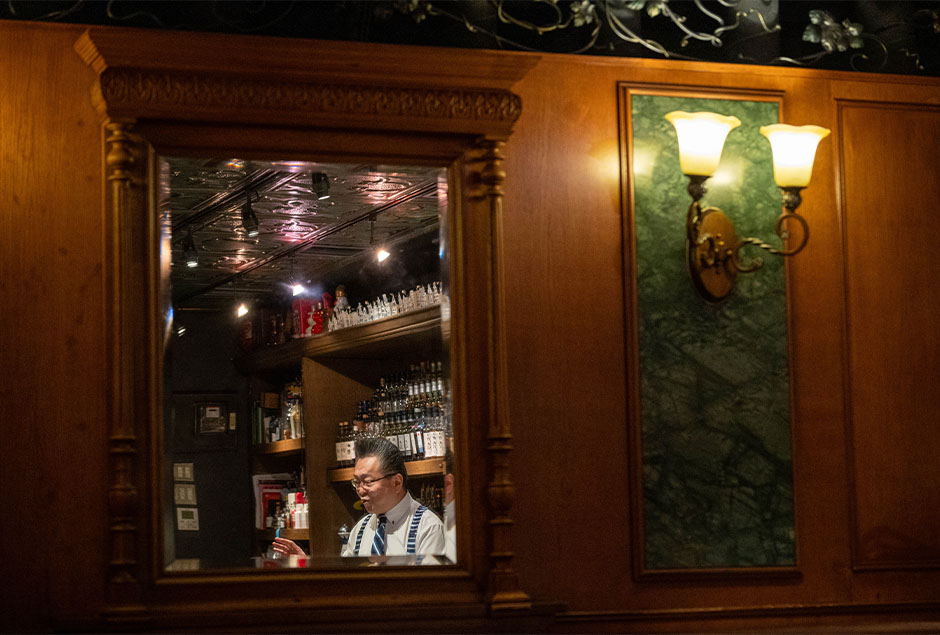
However, I was still an employee of Star Bar, so all of that overseas travel meant taking time off from the bar. After discussing it with Mr. Kishi, we decided that, for one full year, I would accept all work coming from overseas and then sort out which engagements I truly needed to attend and which I could decline in future. In the end, though, there was not a single one that I felt I could afford not to go to. I already had Sundays and public holidays off, but beyond that I was away from the bar for a total of about a month. I felt that was not acceptable for someone in my position as an employee.
I liked being the one quietly supporting Mr. Kishi, while watching the kind of life he would lead as a bartender. I had not the slightest desire to open a bar of my own. But I had a partner, then a child as well, and I began to feel that it was not right to rely on Mr. Kishi to look after me for the rest of my life. So we talked it over and came to the conclusion that the only option was for me to leave Star Bar and go out on my own. That was how I became independent and opened Bar High Five in 2008.
Is This Cocktail to Your Taste?
――So that was why you became independent. By the way, what kinds of things did you learn from Mr. Kishi?
In a word, everything. From ways of thinking to bartending itself, I learned it all from him. But among those things, one realization in particular determined the course of my life. It was the realization that the craft of cocktails has no end. When I was working at Star Bar, I always made a point of asking customers, after serving them a cocktail, “Is this to your taste?” I would prepare each drink according to the balance I believed was right, using techniques I trusted, but alcohol is a matter of personal taste, so my preferences and the customer’s do not necessarily align. That is why, at Star Bar, it was a standing principle that we should always ask whether the drink was to the customer’s taste.
I was asking that question ten years ago, and I still ask it now. I will no doubt still be asking it ten years from now. And when I realized that meant I would go on asking it forever, it became clear to me that there is no end to making cocktails. At Star Bar, I came to understand that this is not a world in which you can ever arrive at a single drink and say, “This is the best,” or, “This will suit everyone.”
My dream had originally been to run a coffee shop, and it was because I realized I could serve alcohol there as well that I ended up working in bars. If the work of a bar could ever be perfected, I would probably have left bartending and gone on to open a coffee shop. But there is no end to making cocktails. And if there is no end, then it is not something you can walk away from. That was when I gave up on my dream of running a coffee shop. I decided to make my living as a bartender.
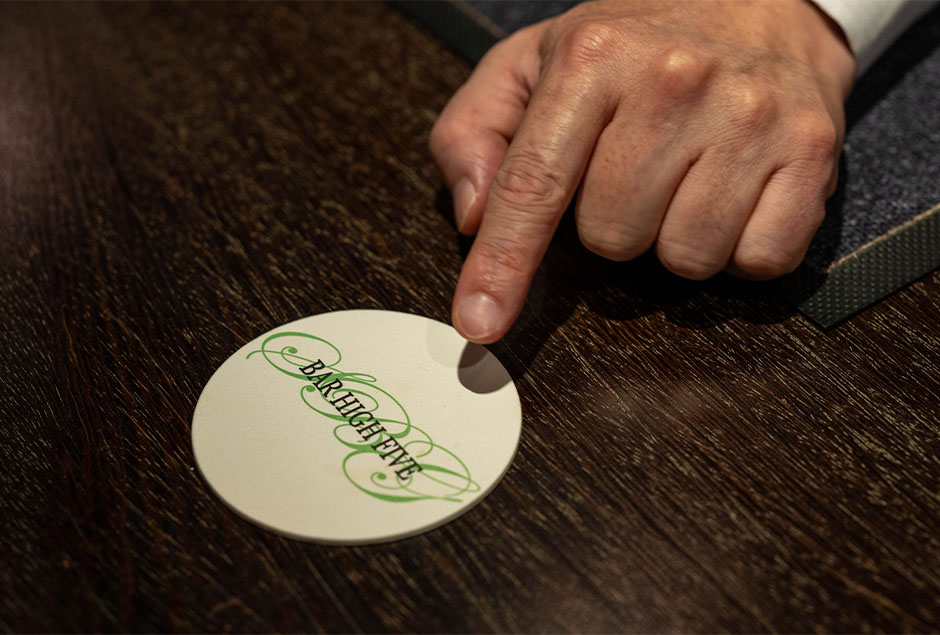
From then on, everything in my life as a bartender was rooted in Star Bar. Do you know what the green line design on Bar High Five’s coaster represents? It spells out “SBG,” short for Star Bar Ginza. I wanted to include something that showed this is where my roots have always been
What Matters More Than Sales, and Must Be Protected
――Videos of you making cocktails can be found online, and they are extremely popular. Your movements especially are widely praised for their beauty.
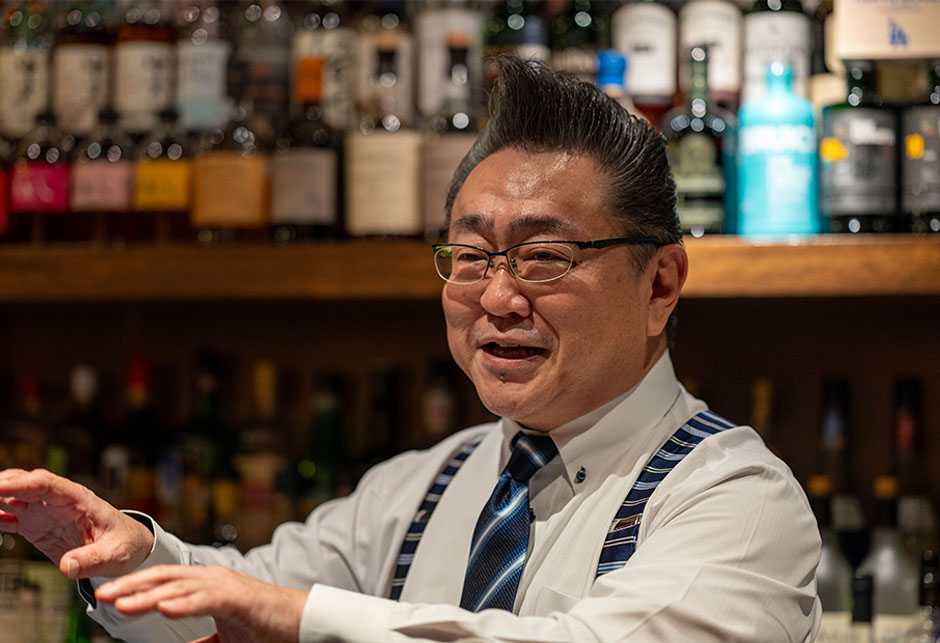
If someone has gone to the trouble of coming to a bar, I want them to watch the bartender in action. Guests who really love bars watch your hands very closely. If I stay conscious of that and work with a certain degree of care, people will sometimes say, “Mr. Ueno, your hands are very graceful.” At moments like that, I am reminded that they really are watching every movement. Whether we are picking up a bottle or holding a single glass, we do it beautifully. The customer’s gaze is focused on our hands. That is something I teach the staff at my bar as well. I do not know whether that would hold up in overseas bars where thirty or forty mojitos are being made one after another, but for us, each individual drink matters more.
I believe Japanese bars have things that are more important than sales, things that must be protected. For example, some people want one last drink, then another, the more intoxicated they become. If a bartender simply keeps serving drinks just to make that one extra sale, the customer may end up completely drunk. Even if they manage to get home safely, they will probably wake up the next day feeling awful. And they may not feel able to come back to the bar that day.
Instead of serving that extra drink, you tell them, “You have had enough for today. Time to go home,” and send them on their way. If they go to sleep, wake up, and think, “Thank goodness, if I had one more drink there, I would have been in real trouble,” then they may come back the next day and have three drinks, saying, “Thank you for stopping me yesterday.” You absolutely have to have the courage not to serve that one extra drink. By choosing not to force that extra drink on someone and letting them go home, that one drink may become three the next day. That is better for both sides, is it not? I think it is important to create an environment where people know they will not be allowed to drink beyond their limits at that bar, but can still go home while they are enjoying themselves.
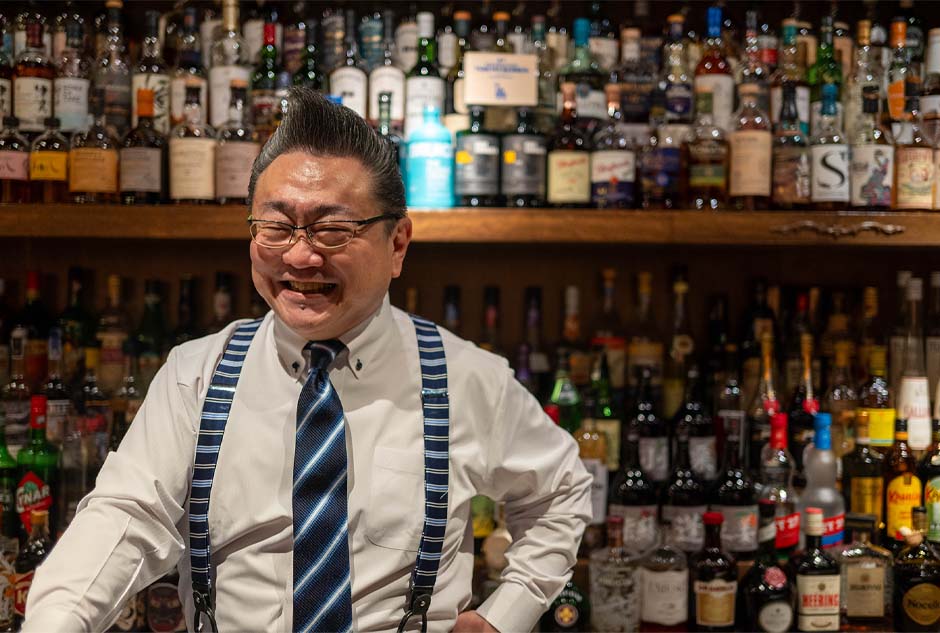
――What are your thoughts on high-ABV honkaku shochu such as iichiko Saiten?
As a Japanese bartender, I am grateful that this kind of shochu now exists. Even if you want to use shochu, when it is only 25% ABV, the spirit lacks strength and the kick is muted. For something like a Shochu Martini to become a standard order at bars in the same way as a Gin Martini or a Vodka Martini, a product like iichiko Saiten is absolutely essential.
That said, if shochu is to become a globally recognized standard base spirit from here on, one expression alone will never be enough. Bars stock dozens of different gins, vodkas, tequilas, and whiskies, after all.
It is also important for the industry as a whole to establish a clear definition of what shochu is, in the same way the Japanese whisky industry has begun doing in recent years. Shochu can be made from a range of ingredients, including barley, rice, and sweet potatoes, but the industry needs to agree on a key defining characteristic, for example, that shochu is a spirit fermented using koji. Gin is straightforward. If it contains juniper berries, it can be called gin.
I think each producer can have its own production secrets, but once the definition of shochu becomes clear, perhaps American-made shochu or Australian-made shochu will begin to appear. And I think that is perfectly fine. Even so, as a pioneer, Sanwa Shurui’s shochu will unquestionably remain at the forefront.