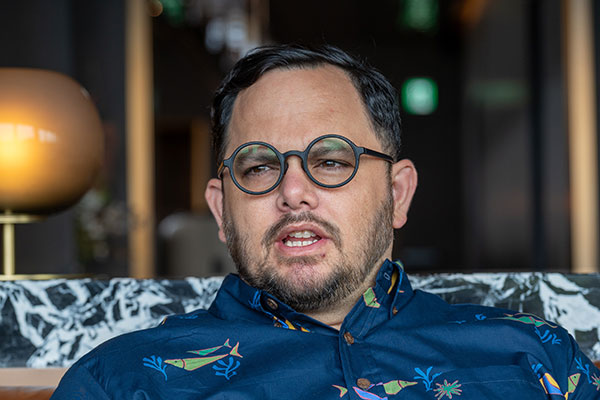
- Justin Park
- Born in Hawaii, Justin entered the food and beverage industry after working at the Honolulu restaurant Buca di Beppo. While serving as bar manager at The Manifest, he became deeply drawn to the world of craft cocktails. He went on to expand his knowledge by visiting renowned bars in New York, including Death & Company and PDT. His accolades include Most Inspired Bartender (Bombay Sapphire/GQ) in 2012, overall winner of the Shake It Up! Cocktail Competition in 2014, and three-time winner of the World’s Best Mai Tai Competition.
In 2015, he co-founded Bar Leather Apron in Honolulu with entrepreneur and friend Tom Park. The bar has garnered attention for its refined hospitality and Justin’s deep expertise in both classic cocktails and innovative craft cocktails, earning recognition such as a ranking of No. 41 in North America’s 50 Best Bars 2023, No. 73 in 2025, and the James Beard Award for Outstanding Bar in 2023—the first bar in Hawaii to receive this honor. In 2021, he opened Bar Maze in Honolulu, a venue centered on pairing food and cocktails. The bar has gained popularity for its high-quality omakase-style experience, pairing the cuisine of co-founder and chef Ki Chung with Justin’s cocktails.
with Bartender
Exploring the journeys and the thoughts that shape globally active bartenders behind the bar.
2026.09.28
Justin Park
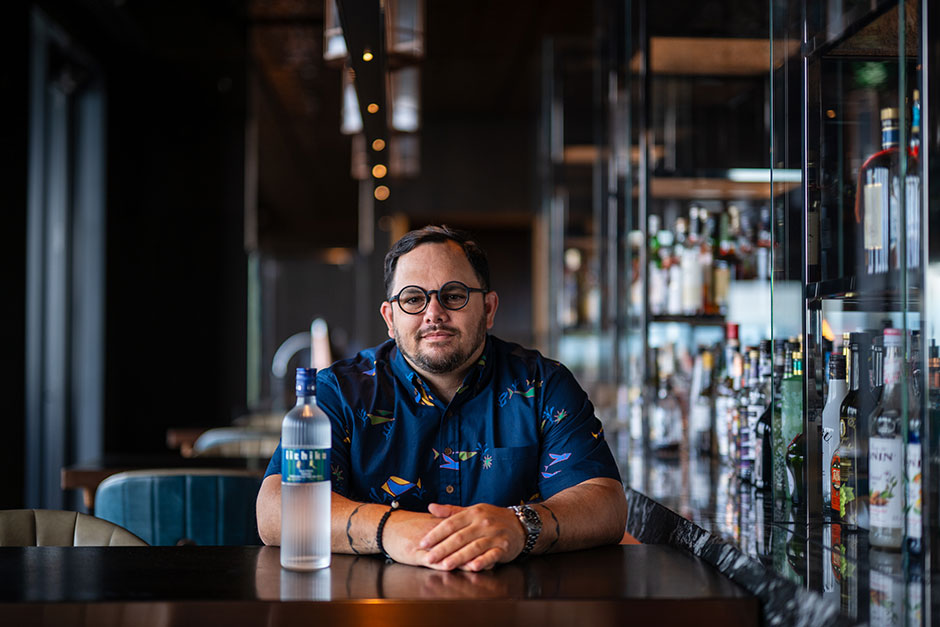
It’s Only When Food and Cocktails Come Together That the Experience Can Truly Be Enjoyed to the Fullest
Driven by a desire above all to create a place where guests can truly relax, Justin Park opened Bar Leather Apron in Honolulu, Hawaii. The bar quickly gained widespread recognition across the United States and around the world. After weathering the challenges of the COVID-19 pandemic, he went on to open Bar Maze, where he offers an omakase-style experience⋆¹, attracting a new audience in the process. We spoke with Justin about the importance he places on “story,” and what guides his thinking when creating menus that bring food and cocktails together.
⋆¹ Omakase-style: A Japanese dining approach where guests leave the menu and its order to the chef, who creates a seasonal, personalized experience based on the ingredients of the day and the guest’s reactions.
Text: Akira Suzuki / Photography: Koichi Mitsui / Composition: Contentsbrain / English Translation : LIBER
Interview Location: Bay, The Ritz-Carlton, Fukuoka (Fukuoka Daimyo Garden City, 2-6-50 Daimyo, Chuo-ku, Fukuoka)
Entrusted With Shaping the Concept of a Bar Founded by a Friend in Hawaii
――What do you think guests are looking for when they come to a bar?
I think the answer is reflected in the bars we have created. They may be places people visit as a kind of “destination,” where they come to enjoy cocktails and spend time. But for me, a bar goes beyond that. Even if you and I share the same experience, the way we feel about it and express it will be different, right? A bar is shaped not only by the experiences we provide, but also by what each individual guest brings with them. All of that comes together to create the space.
In that sense, a bar is also a place where guests experience a story. For example, the history of how a single cocktail came into being and how it has been made over time, or what distinguishes a craft cocktail from a traditional classic cocktail. From the moment a guest takes a seat to the moment they take their first sip, I see that entire sequence of experiences as a story.
I have always placed great importance on telling stories. In the culture I grew up with in Hawaii, storytelling is a vital element. When I first began working in restaurants, I felt as though I was creating stories for guests. And I came to feel that the place where this could be expressed most fully was behind the bar counter, where you welcome guests and convey a story through the experience itself. In that sense, it may well have been what led me to become a bartender.
――Could you tell us a bit more about what you mean by storytelling?
When I talk about “story,” I’m not referring to a single, fixed narrative, but to the act of creating an experience. Everyone who steps into a bar comes for a different reason. And what I personally find fascinating is being able to curate each of those individual, different experiences at the bar. In other words, the experience itself is the story.
――Did your career as a bartender begin at a bar in Honolulu?
Yes. Hawaii—Oahu, in particular—is a small island. When I first started working in the food and beverage industry, my impression was that many bars in Hawaii focused mainly on tropical cocktails made for tourists, and that there were very few places serving serious, classic cocktails. Personally, I wanted to start by making classic cocktails, but in Hawaii there was no mentor I could learn that from. In that environment, I taught myself by gathering information from YouTube and websites, and by visiting bars in major cities such as San Francisco and New York, gradually developing my own understanding of cocktails.
I worked as a bartender at several different venues and was influenced by many people along the way. In particular, I learned a great deal at The Manifest, a bar run by a friend of mine in Honolulu. There, I was allowed to help shape the direction of the bar almost as if I were a co-owner. Because I was constantly thinking about how to show guests what made the bar unique, I wanted to create not only classic cocktails, but also something more distinctive—craft cocktails. To do that, I studied many aspects of cocktail history as well.
It was while I was working at The Manifest that I first developed a real passion and affection for cocktails. During that period, I also began actively entering cocktail competitions. I competed in a wide range of contests, from local competitions in Hawaii to national competitions across the United States. Part of my motivation was the hope that winning would draw more attention to The Manifest.
Things went better than I expected. I was fortunate to receive awards at several competitions, which in turn opened the door for me to take part in international competitions as well. It was through those international events that I first encountered the authentic style of Japanese bartending.
Bar Maze—Incorporating Elements of Japanese Culture
――After receiving numerous prestigious awards in competitions, you went on to found Bar Leather Apron in 2015. From the photos, it appears to be a classic, understated space.
Above all, what I wanted to prioritize with this bar was making sure it did not feel businesslike. Up until then, my work had largely consisted of repeating the same exchange—taking orders, serving cocktails, and collecting payment—and I found that no longer satisfying. Put simply, I wanted to offer an environment where guests could truly relax, something akin to welcoming them into the living room of my own home. The seating is generously spaced, the music ranges from jazz to contemporary, easy-listening Hawaiian music, and the lighting is kept deliberately low to create a calm, comfortable atmosphere.
――Bar Leather Apron received high acclaim, including recognition from North America’s 50 Best Bars and the James Beard Award for Outstanding Bar. But Bar Maze, which opened in 2022, has a concept that is distinctly different from Bar Leather Apron, right?
In developing the concept for Bar Maze, I was strongly influenced by Japanese culture. Even the name comes from the Japanese word mazeru, meaning “to mix,” which we rendered as “Maze.” We serve both food and drinks in an omakase style, modeled after high-end sushi restaurants in Japan. The interior design also draws from Japanese culture, particularly the idea of paying close attention to detail and carefully crafting every element of the space.
――The curtain-like screens on the walls, with their kumiko-inspired design, are very striking.
Kumiko—the traditional craft of assembling intricate wooden pieces to create beautiful patterns—is, to me, a truly symbolic expression of Japanese culture. The wall décor used in the interior of Bar Maze is based on designs inspired by kumiko. On Oahu in Hawaii, two mountain ranges, the Koʻolau Range and the Waiʻanae Range, run across the island. Using kumiko-style patterns, we depicted the Koʻolau Range on one side, and stars and the sun on the other.
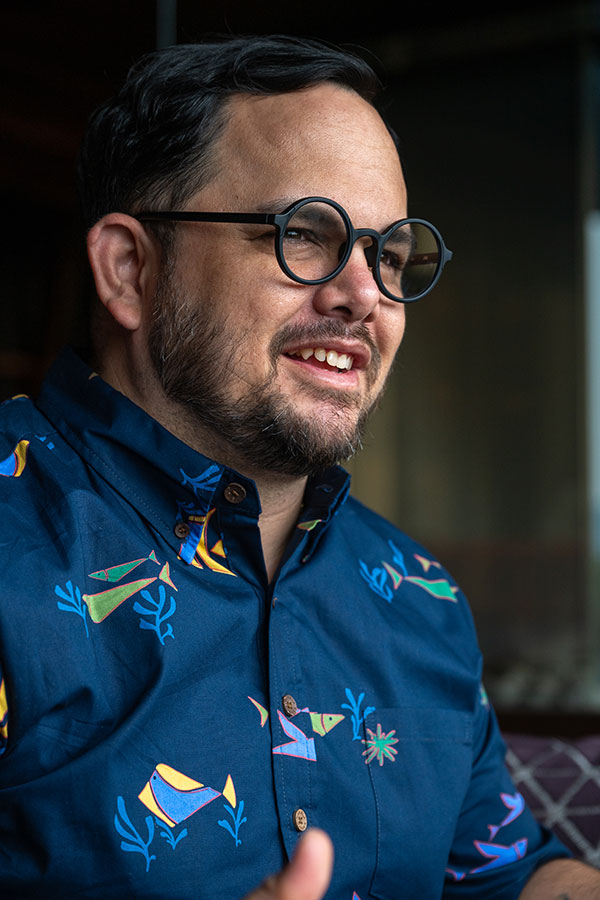
Come to think of it, there’s a bar in Chicago called Bar kumiko, which was opened by Julia Momosé in 2018, where authentic kumiko craftsmanship is used not only in the name but also in the interior design. I was actually surprised when I learned about it—after opening Bar Maze. It was purely a coincidence, so please don’t think we copied anything (laughs).
Originally, the concept for the bar was an izakaya-style cocktail bar—a more casual, standing format where drinks and food would be served tapas-style⋆². However, due to the impact of the COVID-19 pandemic, we had to scrap that plan entirely. That’s when the idea emerged to focus instead on pairing food and cocktails, which became the foundation of the current concept. Inside the bar, we keep the lighting bright, and the music is an eclectic mix—older tracks and newer ones, all blended together.
⋆² Tapas-style: a dining format that originated in Spain, featuring small shared dishes placed across multiple tables for guests to enjoy together.
――Offering both food and drinks entirely omakase is still a relatively unfamiliar service style in the United States. How have guests responded?
Actually, Hawaii is a bit of an exception within the U.S., and the omakase style is relatively well known here. The influence of Japan is strong, and there are many high-end Japanese-style restaurants. That said, these are generally seen not as places for everyday dining, but as “special occasion” restaurants for celebrations and anniversaries. Among them are upscale establishments that offer an omakase experience, and they tend to do very well.
Rules for Creating Food and Cocktail Pairings
――When people think of drinks enjoyed with a meal, wine is usually the standard choice, and with Japanese cuisine, sake or shochu often come to mind. Serving cocktails as pairings with food is a highly innovative approach. When developing the menu, do you start by creating the cocktails and then design the dishes to match, or do you begin with the food and pair the cocktails afterward?
Both approaches are possible. At times, we’ll take one of the ingredients used in a dish and incorporate it into the cocktail. Above all, what matters most to me is that food and cocktails can only be fully enjoyed when they come together as a single experience.
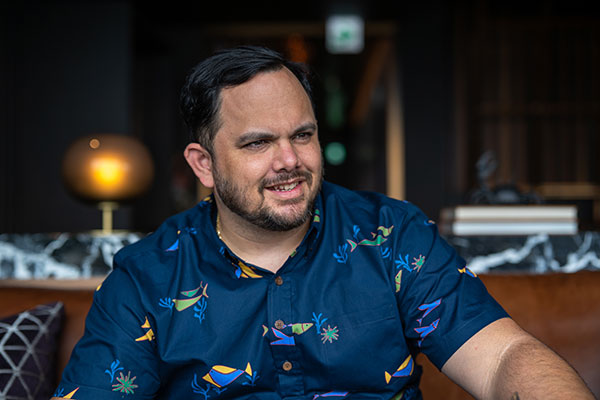
When deciding on a pairing course, we generally follow a fairly established structure. We begin with dishes and cocktails that are light and fresh, followed by something with a bit of acidity. Next comes an element with noticeable texture. By “texture,” I mean, for example, using plenty of butter in a sauce to create richness in a dish, or building layers in a cocktail with ingredients like egg or cream. After that, we move into flavors that are deeper and more complex, and we finish with something sweet.
However, during this recent trip to Japan, I was served rice, pickles, and miso soup at the very end of a meal, and I really loved that. In Hawaii, miso soup is typically served at the beginning of a meal. This experience may give me ideas to rethink and possibly change the way we structure our food and cocktail pairing courses.
Some guests have a high tolerance for alcohol and may drink around five cocktails, which can easily result in a fairly high total alcohol intake. On the other hand, there are also guests who are more sensitive to alcohol. To ensure that both types of guests can enjoy the experience, we aim to keep the cocktails full-flavored while keeping the alcohol content as low as possible. In that respect, standard shochu, with an alcohol content of around 25%, is extremely helpful because it allows us to respond to those needs more easily. In addition, we also offer a selection of non-alcoholic cocktails.
――By the way, when did you first try shochu, and what was your impression of it?
Many restaurants in Hawaii carry shochu, so it has always been something familiar to me. That said, the first time I consciously drank it as shochu was probably about 20 years ago. I remember that it was served mixed with soda, which made it feel very light and extremely easy to drink as a spirit.
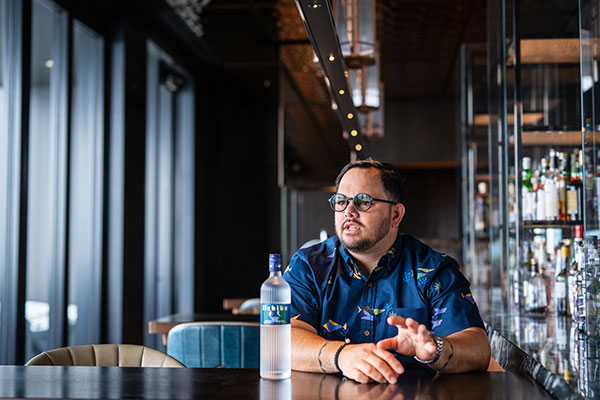
――The honkaku shochu iichiko Saiten has an alcohol content of 43%, making it suitable for use as a cocktail base, much like whisky, gin, or vodka. What was your impression after actually using it in cocktails?
I think this is something not only bartenders but anyone who drinks shochu would notice—iichiko Saiten is quite different from standard shochu. The koji-derived flavors are much more pronounced than in typical shochu. Even when used in cocktails, simply swapping out the shochu you’ve been using for iichiko Saiten won’t result in the same drink. I felt that you really need to reset your assumptions about shochu in order to use iichiko Saiten effectively. In that sense, it could almost be considered a new category of spirit altogether.